

Key Takeaway: My Music Staff is a solid tool for solo instructors, but growing music schools, language centers, and multi-location tutoring businesses need more robust alternatives. The best alternatives to My Music Staff, like Tutorbase, offer AI-powered scheduling, automated multi-branch room management, complex teacher payroll, and integrated billing to reduce admin time by over 60%.
If you're managing a growing music school or tutoring center, you know the tipping point. The manual data entry, fragmented tools, and scheduling conflicts that were once manageable now cost you hours and revenue. You spend 10+ hours a week juggling Google Calendar for scheduling, QuickBooks for billing, and Excel for payroll, leading to double-bookings and invoice errors.
This guide analyzes the 12 best alternatives to My Music Staff, focusing on platforms built to handle the operational complexity of centers with 5 to 100+ teachers. We move beyond simple feature lists to offer a comprehensive resource for your business, comparing each option on its ability to solve critical problems like double-bookings, manual invoicing, and payroll errors. Let's find the right software to streamline your operations.
1. Tutorbase
Tutorbase is an AI-powered, all-in-one management platform designed specifically for growing tutoring centers, language schools, and multi-branch educational businesses. It stands out as one of the best alternatives to My Music Staff by replacing fragmented systems like Teachworks and spreadsheets with a single, unified dashboard for scheduling, billing, payroll, and room management. This platform is engineered for scale, capably handling operations from 5 to over 100 teachers and managing more than 10,000 lessons per week without performance degradation.
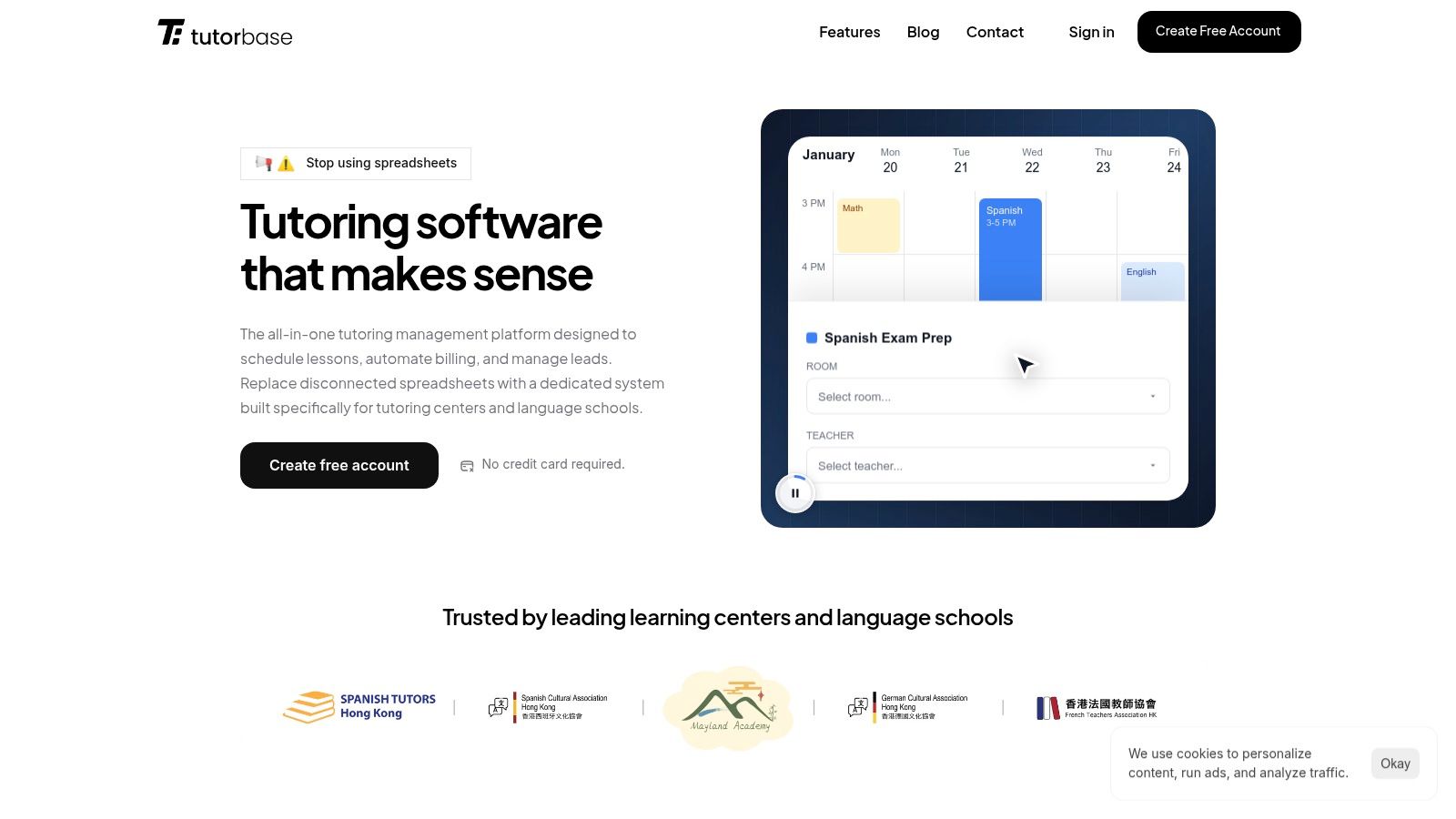
Its core strength lies in deep automation that directly addresses the most time-consuming administrative tasks. For instance, the AI-powered "Find Slot" feature cuts booking time from 10+ minutes to under 2 minutes by intelligently generating optimal teacher, room, and time combinations. This smart scheduling eliminates the double-bookings that plague many growing centers.
The platform's financial tools are equally robust. Billing is automated directly from attendance records, and a native prepaid credit wallet system simplifies payments for packages. Tutorbase also supports complex payroll models, including revenue-share and base-plus-variable compensation, ensuring accurate teacher payments. For businesses with multiple locations, Tutorbase provides centralized control over room bookings, capacity tracking, and even multi-brand management from one account.
Best For: Mid-to-large tutoring centers and multi-branch academies that need to centralize operations and automate complex workflows. It is a powerful choice for owners spending over 10 hours per week on manual admin tasks.
Pros & Cons
Pros:
- Unified Automation: Integrates scheduling, billing, and complex payroll, eliminating the need for separate tools like QuickBooks and Excel.
- Intelligent Scheduling: AI-powered tools like "Find Slot" prevent double-bookings and reduce onboarding time by 3x.
- Built for Scale: Designed to manage multi-branch operations, room capacities, and high lesson volumes without slowing down.
- Flexible Financials: Supports diverse pricing models, prepaid credits, and complex teacher pay structures that competitors lack.
Cons:
- No Public Pricing: Requires a direct inquiry to get a bespoke quote, which may slow the evaluation process.
- Learning Curve: The feature-rich system may be more than a solo tutor needs and requires a dedicated onboarding period.
2. Duet Partner (formerly Music Teacher’s Helper)
Duet Partner, originally known as Music Teacher’s Helper, is a studio management platform designed specifically for the needs of solo music instructors and small, multi-teacher studios. It focuses on simplifying core administrative tasks, such as scheduling and billing, making it an excellent alternative to My Music Staff for educators who want a straightforward, music-centric solution without enterprise-level complexity. The platform excels at automating routine financial workflows, allowing teachers to spend more time on instruction.
Its key strength lies in its approachable design and pricing. The user interface is clean and purpose-built for music lesson management, which minimizes the learning curve. Features like self-scheduling links empower students and parents to book their own time slots based on your availability, reducing back-and-forth communication.
Key Features and Pricing
Duet Partner’s pricing is a significant differentiator. Instead of per-student or per-teacher tiers, it offers a simple, flat monthly fee that includes unlimited students and teachers.
- Pricing: A flat $19.99 per month for all features. It also offers a free plan for studios with up to five students.
- Automated Billing: Supports recurring invoices and accepts online payments via major credit cards, PayPal, ACH, and digital wallets.
- Smart Scheduling: Includes a responsive calendar, automated text reminders, and self-scheduling links for clients.
- Free Trial: Provides a 14-day trial without requiring a credit card, lowering the barrier for new users.
Pros and Cons
Pros:
- Simple, Flat Pricing: Predictable and affordable, especially for growing studios where per-student costs can escalate.
- Music-Studio Focus: Features are tailored for music education, requiring minimal customization.
- Frictionless Adoption: The no-credit-card trial and free tier make it easy to test the platform.
Cons:
- Transaction Fees: Charges a 1% platform fee on top of standard payment processor fees (e.g., Stripe, PayPal).
- Limited Scalability: The feature set is geared toward smaller operations and may not support the complex needs of large academies or multi-branch centers that require advanced features like a dedicated music academy CRM.
Official Website: https://www.duetpartner.com/
3. TeacherZone
TeacherZone is an all-in-one management platform designed for music and performing arts schools that need more than just administrative tools. It uniquely combines scheduling, billing, and CRM functionalities with a built-in Learning Management System (LMS), making it a powerful alternative to My Music Staff for schools focused on structured curriculum delivery. This integrated approach allows educators to manage business operations and deliver lesson content from a single, unified dashboard.
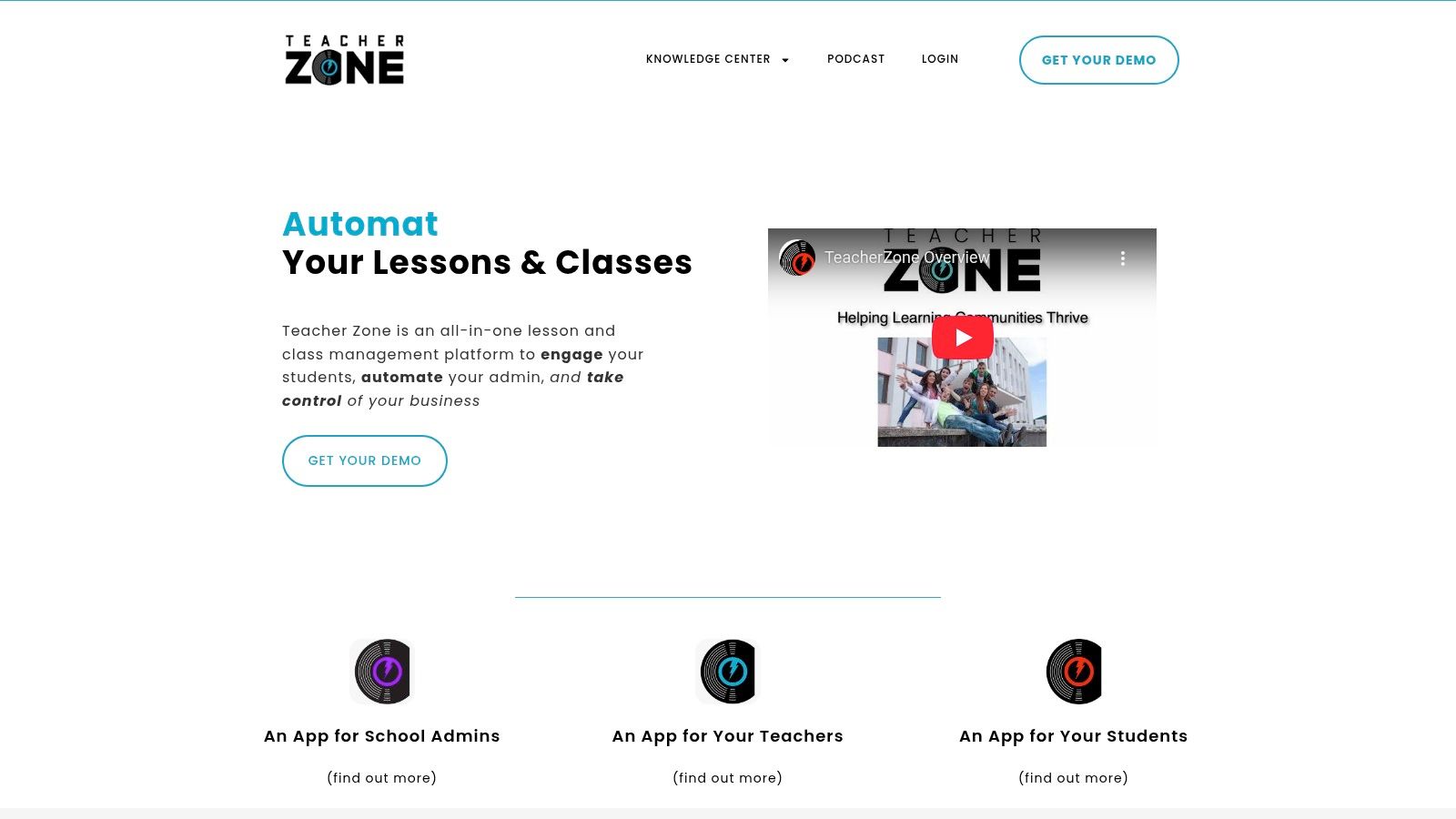
The platform's standout feature is its combination of business management and educational delivery. Instructors can upload video lessons, create courses, and assign practice materials directly within the system that also handles their scheduling and invoicing. This makes TeacherZone ideal for studios that offer hybrid learning, online courses, or want to provide students with a rich library of digital resources to supplement in-person instruction.
Key Features and Pricing
TeacherZone uses a tiered pricing model based on the number of active students, which helps studios predict their monthly costs as they grow. All plans include core administrative and learning features.
- Pricing: Plans start from $49/month for up to 25 students and scale up based on student count. Custom pricing is available for large schools.
- Integrated LMS: Features unlimited video hosting, allowing teachers to build and share a library of lesson content and assignments.
- Comprehensive Communication: Includes automated text and email notifications for reminders, payments, and studio announcements.
- Advanced Administration: Supports multi-teacher logins with sub-admin roles, detailed attendance tracking, and automated make-up lesson handling.
Pros and Cons
Pros:
- Unified Platform: Combines administrative tools with an LMS, eliminating the need for separate software for lesson delivery.
- Scalable Pricing: The tiered, student-based pricing is predictable and accommodates growth from small studios to larger academies.
- Enhanced Student Engagement: Built-in video and course features provide students with valuable learning resources outside of their scheduled lesson time.
Cons:
- Higher Entry Price: The starting price point is higher than tools designed exclusively for solo teachers.
- Niche Focus: While excellent for music and arts, its specialized feature set may be less suitable for general academic tutoring centers.
Official Website: https://www.teacherzone.com/
4. Jackrabbit Music
Jackrabbit Music is a long-standing and robust management platform designed for scale. While it serves the broader youth activity market, its music-specific vertical provides specialized tools for larger music schools and academies. It is a strong alternative to My Music Staff for established businesses that prioritize comprehensive features like point-of-sale (POS), advanced reporting, and multi-location management over the simplicity needed by solo instructors. The platform is trusted for its reliability and ability to handle high student volumes.
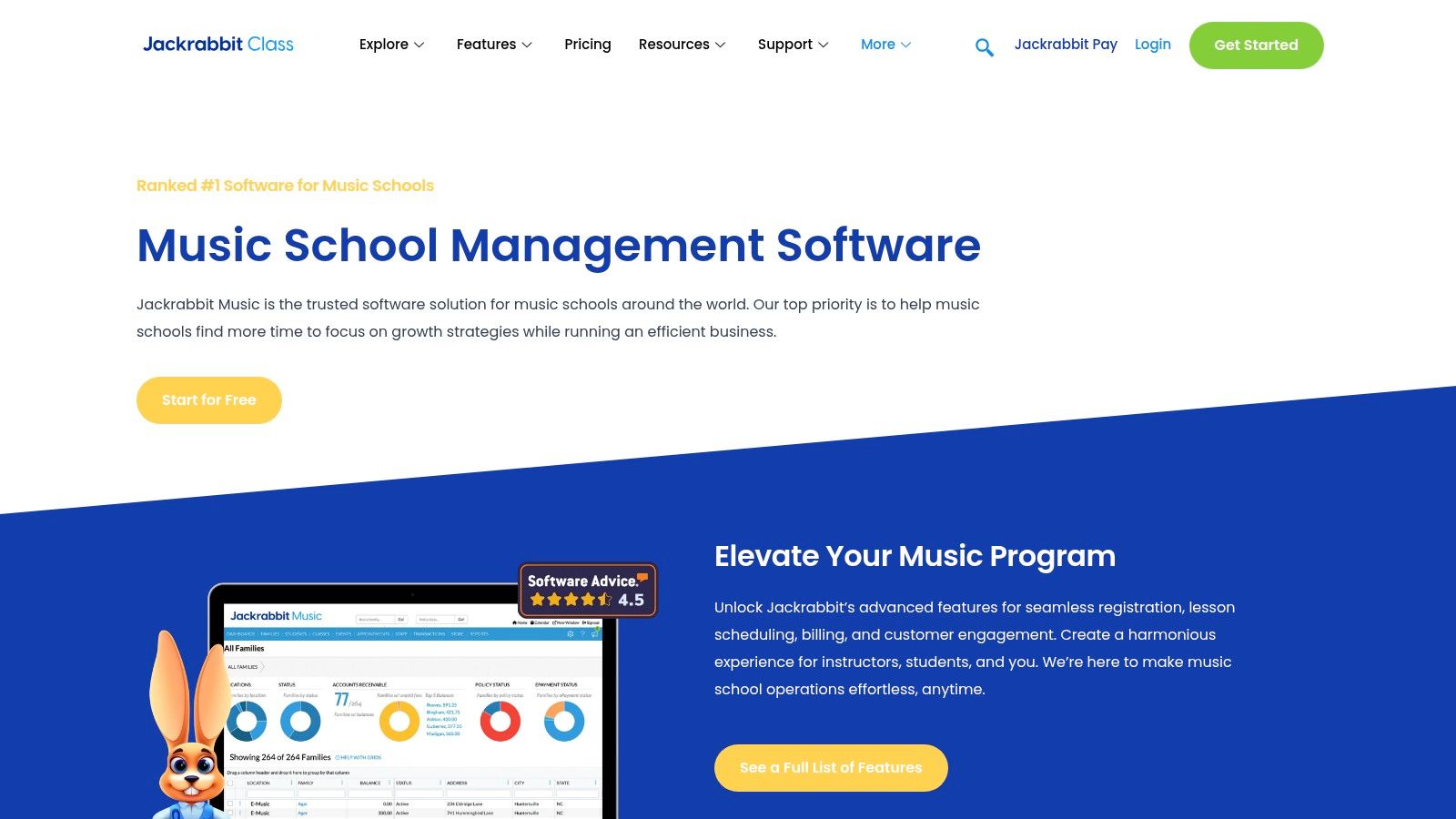
Its core strength lies in its all-in-one, enterprise-oriented approach. Features such as a time clock for staff, detailed financial reporting, and a powerful online registration system with a parent portal make it a central hub for all school operations. This allows directors to manage everything from class enrollment to inventory sales without relying on multiple disconnected systems.
Key Features and Pricing
Jackrabbit Music uses a tiered pricing model based on the number of active students, which scales as your school grows. It also includes a 30-day money-back guarantee.
- Pricing: Tiered pricing starts at $45 per month for up to 50 students and increases with student count.
- Online Registration and Parent Portal: Allows parents to register, view schedules, and make payments online, reducing administrative workload.
- Comprehensive Reporting: Offers a wide range of reports on enrollment, financials, and class attendance to inform business decisions.
- Time Clock and POS: Includes built-in tools for tracking staff hours and selling merchandise like books or instruments.
Pros and Cons
Pros:
- Scales Well: The platform is proven to handle the needs of large, multi-location music academies and youth programs effectively.
- All-in-One Functionality: Combines scheduling, billing, POS, and staff management into a single system.
- Clear Pricing Tiers: The student-based pricing is transparent, and the 30-day trial option reduces risk.
Cons:
- Enterprise Feel: The interface and setup process can feel complex and less intuitive for small, independent studios.
- Less Transparent Music-Specific Details: Finding detailed pricing and feature information specifically for the music vertical can be challenging on their site.
Official Website: https://jackrabbittech.com/products/jackrabbit-music/
5. Opus1.io
Opus1.io is a modern, enterprise-grade studio management platform built specifically for established music schools, especially those with multiple teachers and locations. It goes beyond basic scheduling and billing to provide an end-to-end operational toolkit that includes lead management, teacher payroll, and recital planning. This focus on the entire music school workflow, from initial inquiry to student retention, makes it a powerful alternative to My Music Staff for businesses aiming to scale.
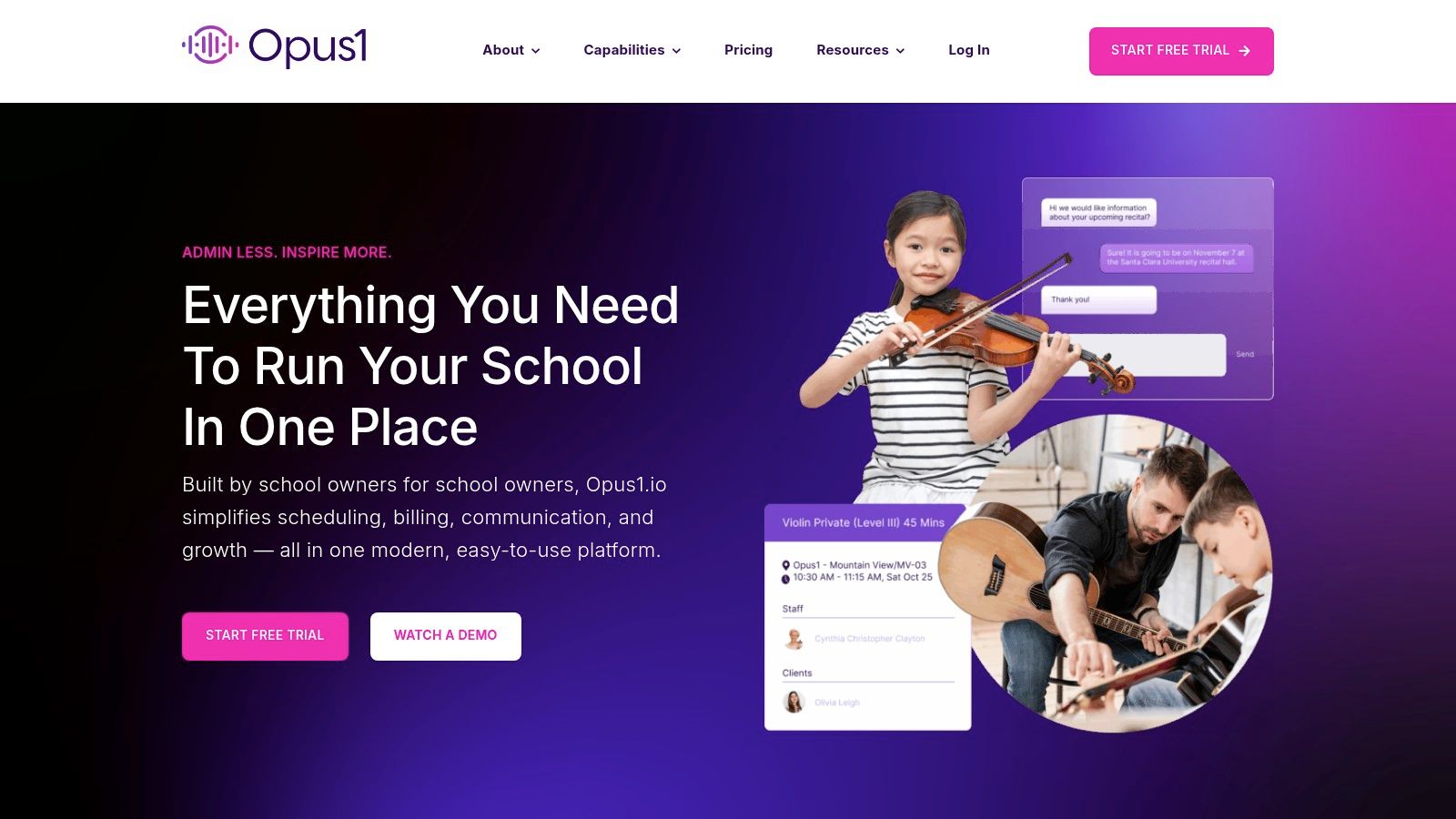
Its core strength is in automating student acquisition and conversion. Features like smart waitlists, automated trial lesson conversions, and integrated proposal tools help schools grow their student base systematically. The platform's advanced reporting and business intelligence features also give owners deep insights into their operations, from teacher payroll costs to revenue analytics, which is crucial for multi-branch management.
Key Features and Pricing
Opus1.io offers tiered pricing based on the number of active students, with plans designed to accommodate growing schools.
- Pricing: Plans start around $59 per month for up to 25 students and scale upwards. Additional costs may apply for add-ons like SMS/voice communication packages.
- Student Acquisition Tools: Includes a built-in CRM for lead management, self-booking for trial lessons, and smart waitlists to fill open slots automatically.
- Advanced Payroll: Manages complex teacher payroll scenarios with varied pay rates and performance-based compensation.
- Built-in Communications: Integrated email and SMS tools help manage reputation and keep clients informed.
Pros and Cons
Pros:
- All-in-One Growth Platform: Combines CRM, scheduling, billing, and payroll into a single system designed for scaling a music school.
- Focus on Performing Arts Workflows: Features are tailored for the specific needs of music education, such as recital management and trial conversions.
- Migration Support: Offers assistance for schools moving from other platforms, easing the transition process.
Cons:
- Higher Starting Cost: The entry-level price is higher than tools built for solo instructors, making it less suitable for very small studios.
- Potential for Added Costs: Essential communication and marketing features are often add-ons, which can increase the total monthly subscription fee.
Official Website: https://www.opus1.io/
6. Teachworks
Teachworks is a versatile management platform built for tutoring centers, music schools, and other lesson-based businesses. It offers a comprehensive suite of tools for scheduling, billing, and payroll, making it a strong alternative to My Music Staff, especially for organizations that manage both individual and group lessons. The platform’s unique selling point is its transparent, usage-based pricing model, which can be highly cost-effective for studios with fluctuating class sizes.
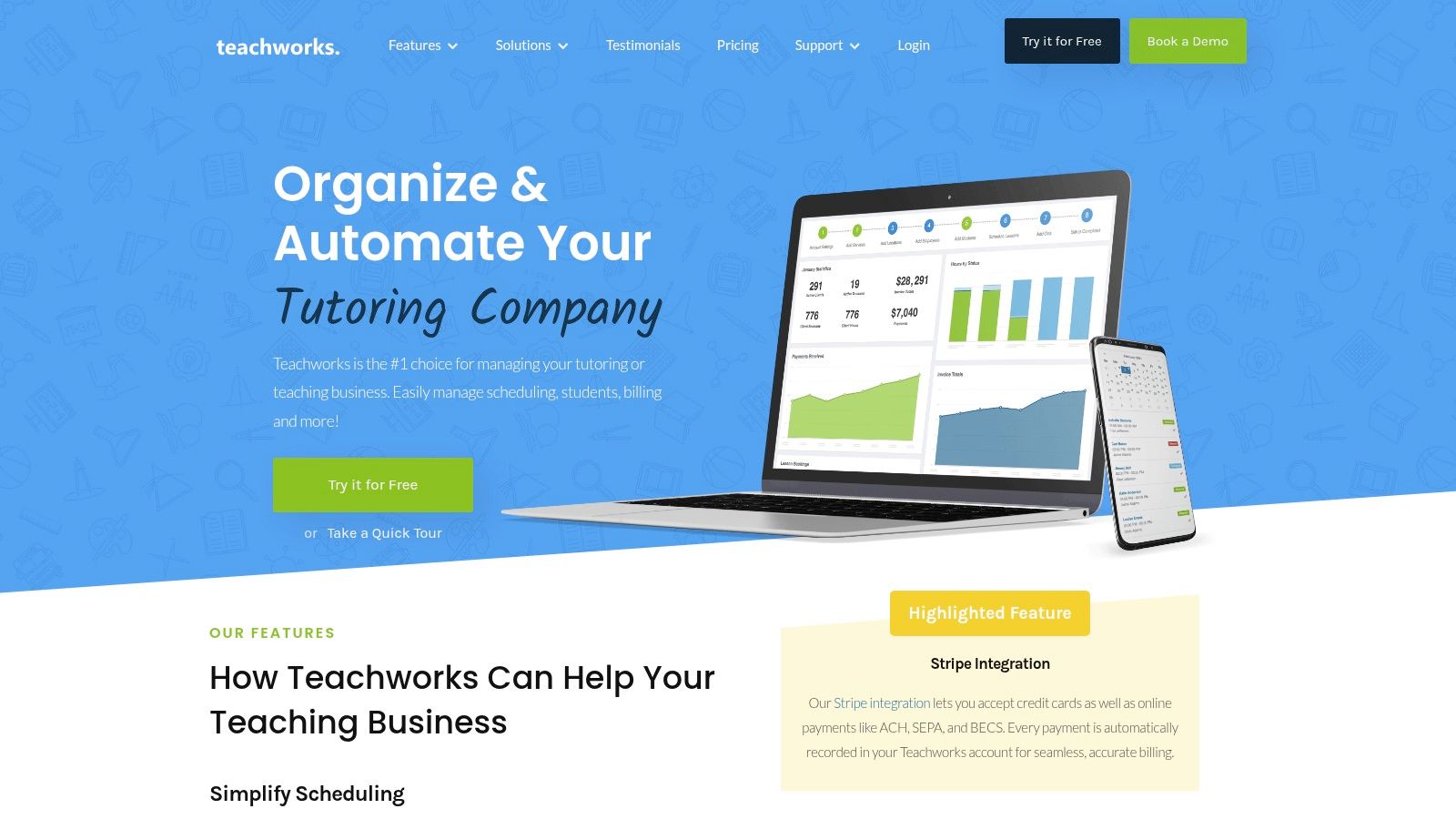
Its strength lies in scalability and flexibility. Unlike platforms with rigid per-student tiers, Teachworks adapts to your lesson volume. This allows small but growing studios to access advanced features without a steep initial investment. For larger, multi-branch organizations, its API access on higher tiers enables custom integrations, offering a degree of customization not found in many simpler alternatives.
Key Features and Pricing
Teachworks' pricing is based on the number of lessons scheduled each month, with discounts applied for group lessons. This model is unique among its competitors and favors schools with a high volume of group classes. All plans include unlimited students and staff.
- Pricing: Starts at $15.95/month for up to 50 lessons, scaling up based on lesson volume. Group lesson discounts apply.
- Flexible Scheduling & Billing: Manages complex schedules and automates invoicing based on attended lessons. For more information, you can explore reviews of tuition management systems.
- Integrations and API: Offers multiple integrations and provides API access on its Growth and Enterprise plans for custom solutions.
- Free Trial: A generous 21-day free trial is available, allowing ample time to evaluate the full feature set.
Pros and Cons
Pros:
- Economical for Group Classes: The usage-based pricing with group discounts can make it more affordable than per-student models.
- Scalable for Growth: The feature set supports operations from single tutors to multi-branch academies.
- Unlimited Users: All plans support unlimited students and teachers, removing a common growth barrier.
Cons:
- Variable Monthly Costs: Per-lesson fees create unpredictable monthly bills, which can complicate budgeting.
- Less Music-Specific: Lacks some of the dedicated music learning management (LMS) features found in platforms like TeacherZone or Opus1.
Official Website: https://teachworks.com/
7. TutorCruncher
TutorCruncher is a powerful business management platform designed for tutoring companies, making it a strong contender for music schools that operate more like agencies. While not exclusively music-focused, its strengths in client relationship management (CRM), advanced billing, and payroll make it a viable alternative to My Music Staff. It's particularly well-suited for studios managing a client pipeline or those that need robust financial controls and reporting.
The platform’s agency-centric design provides tools like lead pipelines and customizable communications, which are less common in dedicated music studio software. This allows a growing school to manage prospective students from inquiry to conversion. Features like automatic payments and flexible payroll cater to businesses with complex financial structures, including split payments between the school and instructors.
Key Features and Pricing
TutorCruncher offers tiered pricing based on the number of active teachers and students, with plans designed to scale alongside a business's growth.
- Pricing: Starts at $25/month for a solo user (Pay-as-you-go) and offers plans like Starter ($45/month) and Premium ($120/month) for larger teams.
- Automatic Payments and Payroll: Streamlines financial workflows with automated invoicing, online payments, and sophisticated payroll options, including split payments.
- CRM and Pipelines: Manage leads and track prospective clients through a built-in pipeline, a feature often missing in music-specific software.
- Custom Communications: Offers customizable email templates and an optional SMS add-on for professional client communication.
Pros and Cons
Pros:
- Flexible Pricing Tiers: The tiered structure, including a low-cost entry plan, makes it accessible for startups and growing studios.
- Comprehensive Documentation: Extensive support resources and clear documentation help users navigate its broad feature set.
- Strong Financial Tools: Advanced payroll and billing automation are ideal for managing agency-style payment structures.
Cons:
- Not Music-Specific: Some music school workflows, like instrument tracking or recital planning, may require creative workarounds.
- Complex Subscriptions: Setting up recurring monthly charges requires generating an invoice first, which adds an extra step compared to native subscription models.
Official Website: https://tutorcruncher.com/
8. Fons
Fons is a lightweight scheduling and automated payment platform designed for independent teachers and small studios who want to eliminate the administrative burden of billing. Its primary focus is to make getting paid automatic and effortless, positioning it as a strong My Music Staff alternative for educators who prioritize financial automation over an all-in-one studio management system. The platform is built around a "set it and forget it" billing philosophy.
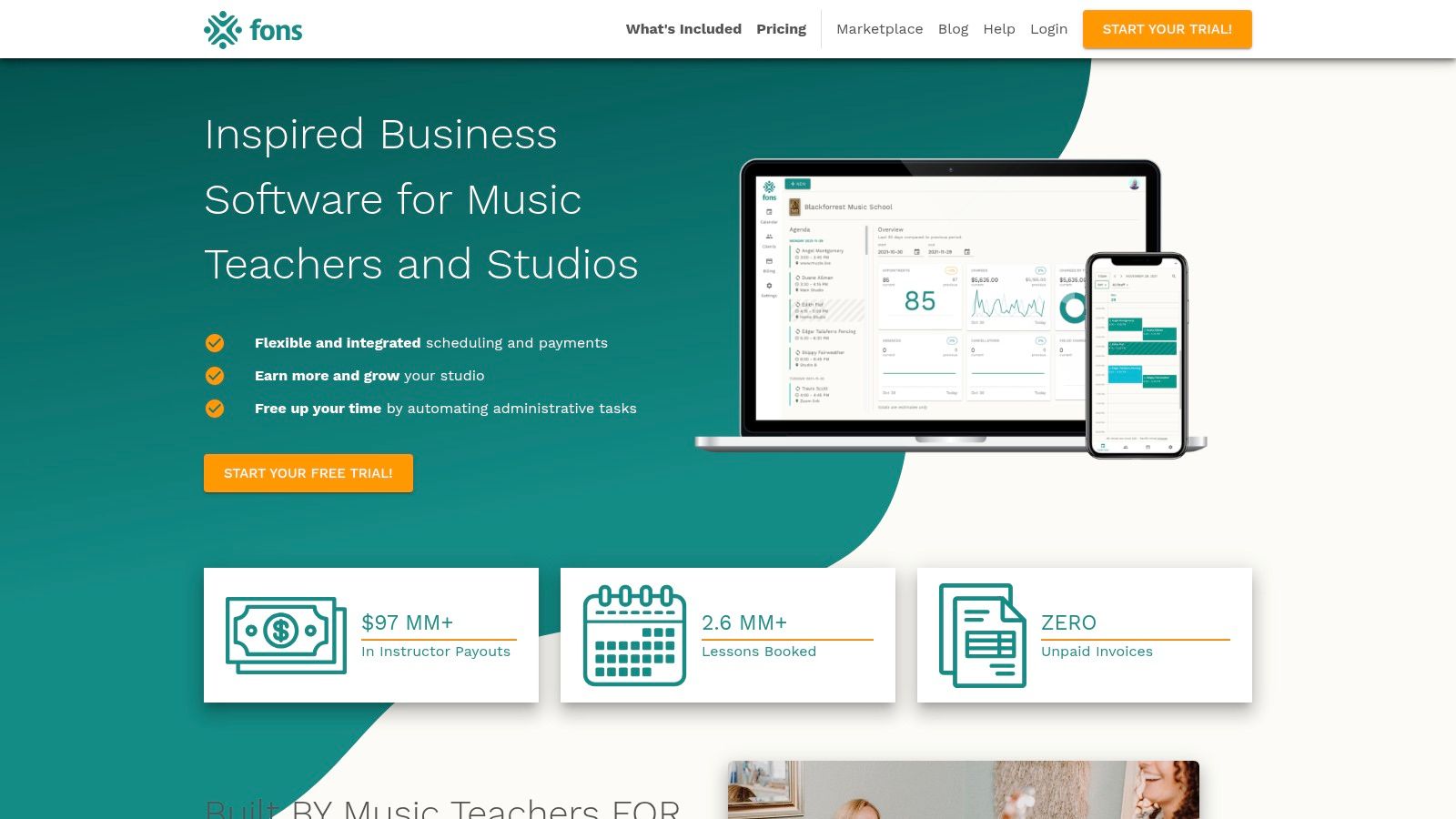
Its core strength is its powerful, automated invoicing engine that handles recurring payments seamlessly. Once a student's schedule and payment plan are set, Fons runs the process in the background, charging clients on schedule and significantly reducing the time spent chasing payments. This allows solo instructors to operate more like a subscription service, ensuring predictable cash flow.
Key Features and Pricing
Fons offers a simple pricing structure that scales with the size of the business, focusing on a low base price with affordable add-ons for additional staff members.
- Pricing: Starts at $29.95 per month for a solo provider, with additional staff members costing $14.95 per month each.
- Automatic Billing: Supports recurring subscriptions, per-appointment billing, and lesson packages with automatic payment collection.
- Flexible Scheduling: Features an online booking portal, staff availability management, and automated appointment reminders.
- Payment Processing: Integrates with Stripe for secure credit card and ACH payments, including configurable cancellation policies.
Pros and Cons
Pros:
- Low Administrative Overhead: The automated billing system is a primary benefit, virtually eliminating manual invoicing and payment chasing.
- Affordable for Solo Teachers: The base plan is competitively priced for individual instructors, with predictable costs for adding staff.
- Simple and Focused: The interface is clean and centered on scheduling and payments, making it easy to learn and use.
Cons:
- Limited School Management Features: Lacks advanced functions like learning management (LMS), inventory tracking, or complex teacher payroll needed by larger schools.
- Inconsistent Pricing Information: Legacy plans and promotions can sometimes cause confusion, so checking the official site for current rates is essential.
Official Website: https://www.fons.com/
9. Pike13
Pike13 is a comprehensive business management platform designed for service-based businesses, including large music franchises and multi-site schools. It stands out as one of the best alternatives to My Music Staff for organizations that have scaled beyond a single studio and require enterprise-grade tools for managing memberships, complex schedules, and franchise-style operations. Its strength lies in providing operational rigor and brand consistency across multiple locations.
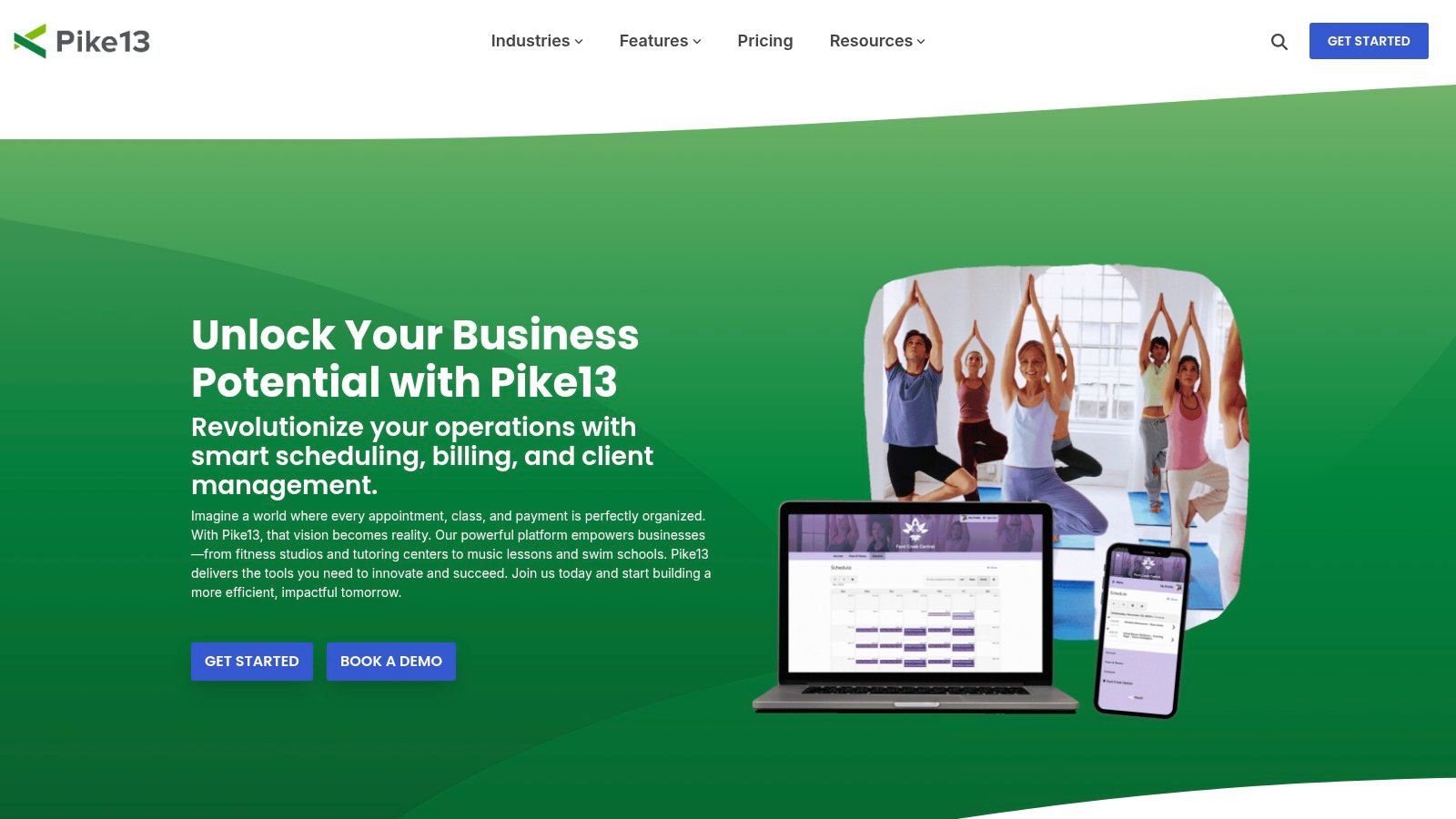
The platform is built for scale, supporting everything from private appointments and group classes to waitlists and complex membership billing. Its mobile-first design ensures both clients and staff have a smooth experience on any device, which is crucial for modern, tech-savvy music schools. For large operations, features like branded apps and kiosk check-in options provide a professional touch and streamline front-desk management.
Key Features and Pricing
Pike13’s pricing model is tailored to larger businesses and franchises, often requiring a sales consultation to get a precise quote based on specific operational needs.
- Pricing: Custom pricing based on business size and feature requirements. A sales-led approach means there are fewer public pricing tiers.
- Multi-Location Management: Centralized dashboard for overseeing schedules, staff, and billing across all branches. Learn more about how Pike13 helps with multi-location scheduling software.
- Flexible Scheduling: Supports appointments, classes, workshops, and recurring events with advanced waitlist management.
- Mobile Experience: Offers branded mobile apps for clients and dedicated staff apps for on-the-go management.
- Robust Integrations: Connects with other business tools and provides options for kiosk check-ins, ideal for busy youth programs.
Pros and Cons
Pros:
- Proven at Scale: Trusted by large franchises like School of Rock, demonstrating its reliability for high-volume operations.
- Built for Multi-Location: Excels at standardizing processes, reporting, and client experiences across multiple sites.
- Strong Membership Tools: Advanced features for managing recurring memberships, packages, and automated billing.
Cons:
- Opaque Pricing: The lack of public pricing can be a barrier for smaller studios evaluating their options.
- Generalist Platform: It is not purpose-built for music education, so music-specific features (e.g., instrument tracking, recital planning) may require workarounds or configuration.
10. WellnessLiving
While primarily known in the fitness and wellness industries, WellnessLiving is a powerful all-in-one business management platform that serves music and arts schools effectively. It stands out as a strong alternative to My Music Staff for organizations needing robust CRM, marketing automation, and branded app capabilities. Its comprehensive feature set is designed to help businesses not only manage operations but also actively grow their client base through integrated marketing and lead management tools.
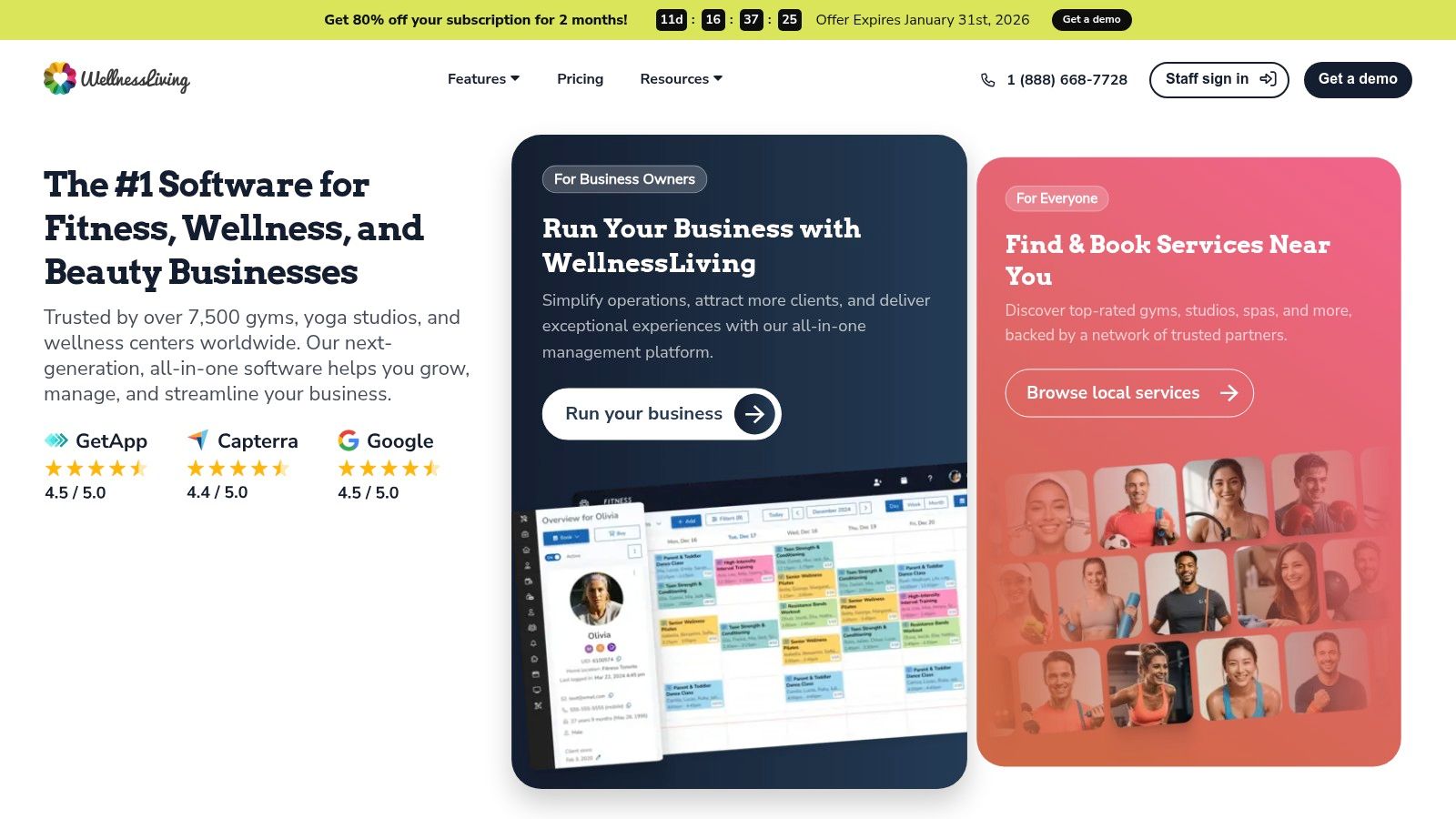
The platform’s key strength is its combination of aggressive pricing and an enterprise-grade feature stack. Schools can create branded client and staff apps, launch automated email and SMS campaigns, and manage leads through a built-in pipeline. This makes it a great fit for growing schools that want to consolidate their marketing and management software into a single, cost-effective solution.
Key Features and Pricing
WellnessLiving offers tiered pricing based on features and staff members, with frequent promotions that make it highly competitive. They also provide free migration support to ease the transition from other systems.
- Pricing: Plans typically start around $59 per month, with higher tiers unlocking advanced marketing, payroll, and API access. Custom enterprise plans are available.
- Branded Apps and Portals: Offers dedicated client and staff mobile apps, along with a branded web portal for a seamless customer experience.
- Marketing and CRM: Includes tools for email/SMS campaigns, lead management with drip sequences, and a directory listing (Explorer) to attract new students.
- Free Migration: Provides complimentary data migration support, reducing a significant barrier to switching platforms.
Pros and Cons
Pros:
- Full-Stack Marketing Suite: The integrated CRM and communication tools are more advanced than many music-specific platforms.
- Highly Scalable: The architecture supports multi-location and enterprise-level operations with parent/HQ account structures.
- Aggressive Pricing: Often runs promotions that offer significant value compared to competitors with similar feature sets.
Cons:
- Generalist Focus: The platform is not built exclusively for music education, so music-specific workflows may require initial customization and setup.
- Additional Costs: High-volume SMS messaging and other add-ons can increase the monthly subscription cost.
Official Website: https://www.wellnessliving.com/
11. Sawyer for Business (Sawyer Tools)
Sawyer for Business, often called Sawyer Tools, is a registration, scheduling, and payment platform built specifically for children's activity providers. This makes it an interesting alternative to My Music Staff for music schools that heavily rely on camps, group classes, workshops, and seasonal enrollment. Its key differentiator is an optional marketplace listing that helps providers acquire new families actively searching for local kids' activities.
The platform is designed around program-based scheduling rather than continuous one-on-one lessons, excelling at managing semesters, summer camps, and class packs. It provides robust marketing and messaging tools to help schools communicate with parents and promote their offerings effectively, filling a common gap in more traditional studio management software.
Key Features and Pricing
Sawyer’s pricing is tiered, accommodating businesses of different sizes and needs. The plans offer a mix of flat fees and transaction-based charges, particularly for those using its marketplace for customer acquisition.
- Pricing: Three tiers available, from a $0/month plan (with a 30% marketplace fee) to custom enterprise pricing. Mid-tier plans start around $129/month plus processing fees.
- Program-Focused Scheduling: Optimized for managing camps, workshops, group classes, and semesters with support for online and in-person formats.
- Marketing and Growth Tools: Includes an optional marketplace listing to attract new students, plus integrated messaging and reporting features.
- Flexible Registration: Supports gift cards, class packs, and flexible payment options for parents.
Pros and Cons
Pros:
- Strong for Youth Programming: Ideal for schools focused on group classes, seasonal camps, and workshops.
- Built-in Customer Acquisition: The optional marketplace provides a direct channel to attract new families.
- Tiered Plans: Offers flexibility for studios of different sizes and budgets to choose a suitable feature set.
Cons:
- High Marketplace Fees: The 30% fee on the entry-level plan can be very costly for new customer bookings.
- Less Suited for Traditional Studios: Not optimized for the advanced payroll or complex one-on-one scheduling needs of conservatory-style music schools.
Official Website: https://www.hisawyer.com/business
12. ClassBug
ClassBug is a streamlined class management platform designed for studios and schools that prioritize simple enrollment and cost-effective payment processing. It serves as an excellent alternative to My Music Staff for organizations that need straightforward online registration and automated billing without a complex feature set. The platform’s main appeal is its focus on making it easy for parents to sign up and pay, combined with low processing fees for e-checks, which directly benefits budget-conscious studios.
Its strength lies in its quick setup and financial management tools. ClassBug allows you to create an online store or portal where clients can register, manage family accounts, and handle payments through AutoPay installment plans. This self-service approach reduces administrative workload, while features like automated discounts, waitlists, and point-of-sale capabilities cover core operational needs for smaller, class-based programs.
Key Features and Pricing
ClassBug’s pricing model is based on a flat monthly fee, making it predictable and affordable for studios of various sizes. Its payment processing options are a key differentiator.
- Pricing: Starts at $79 per month for the Core plan, which includes most essential features for managing classes and billing.
- Cost-Effective Payments: Offers lower e-check (ACH) processing fees at 1.5% + $0.30 per transaction, providing significant savings over standard credit card rates.
- Online Registration and Store: Provides a client-facing portal for enrollment, family account management, and point-of-sale transactions.
- Automated Billing: Supports recurring AutoPay installment plans, automated fees, and custom discounts.
Pros and Cons
Pros:
- Affordable and Predictable Pricing: The flat monthly fee is easy to budget for and scales well as you add students.
- Lower Transaction Costs: The e-check option helps studios control payment processing expenses, a major operational cost.
- Quick to Launch: Its straightforward interface and focused feature set allow for rapid implementation.
Cons:
- Lean Reporting: Lacks the in-depth analytics and custom reporting found in more enterprise-focused systems.
- Fewer Music-Specific Features: It does not include specialized tools like recital planning, instrument tracking, or tiered teacher payroll common in dedicated music school software.
Official Website: https://classbug.com/
Top 12 My Music Staff Alternatives Comparison
| Product | Core features | Best fit / Target | Unique selling point | Pricing | Scale / Admin impact |
|---|---|---|---|---|---|
| Tutorbase | AI scheduling (Find Slot/Spot), auto billing from attendance, payroll, multi-branch rooms, leads, prepaid credits | Tutoring centers, language schools, test-prep, multi-branch ops (5–100+ teachers, 50–10k lessons/wk) | AI-driven slot/spot scheduling, zero double-bookings, advanced payroll, WhatsApp lead capture | Custom / quote-based (by branches & volume) | Scales 10k+ lessons/wk; ~60% admin time reduction, 3x faster onboarding |
| Duet Partner (Music Teacher’s Helper) | Automated invoices, smart scheduling, parent/student portal, online payments | Solo and small multi-teacher music studios | Purpose-built for music with low setup friction, flat pricing | Flat/low plans, free plan & 14‑day trial; 1% transaction fee + processor fees | Great for small studios; limited enterprise features |
| TeacherZone | Scheduling, billing, CRM, unlimited video/LMS, attendance tools | Music & performing-arts schools, multi-location programs | Integrated LMS + admin tools for lesson delivery | Tiered student-count pricing (predictable) | Scales to schools; higher entry price |
| Jackrabbit Music | Online registration, parent portal, billing, POS, reporting | Large academies, youth programs, multi-branch organizations | Proven reliability and reporting for large programs | Tiered by active student count; trials / guarantees | Enterprise-oriented, strong reporting & time-clock |
| Opus1.io | Self-booking, trial conversion, payroll, CRM, analytics, recitals | Established multi-teacher, multi-location music schools | End-to-end performing-arts workflows, migration support | Higher starting price; add-ons (SMS/voice) add cost | Built for multi-location scale and advanced reporting |
| Teachworks | Scheduling, billing, payroll, API, integrations | Tutoring and music schools with variable class sizes | Fine-grained, usage-based pricing suited to group lessons | Per-lesson usage fees; 21-day free trial | Scales well but month-to-month fee variability |
| TutorCruncher | Scheduling, payments/payroll, CRM, reporting, pipelines | Lesson-based businesses, agencies, tutoring companies | Strong CRM/pipeline and flexible tiering for agencies | Tiered plans with low-base options | Comprehensive feature set; not music-specific |
| Fons | Recurring billing, online booking, ACH/card payments, reminders | Independent teachers, very small studios | Minimal admin — automated billing & low overhead | Low base price, affordable staff add-ons | Excellent for solo teachers; limited payroll/LMS |
| Pike13 | Classes, memberships, scheduling, branded mobile apps, kiosks | Large franchises and multi-site schools (e.g., School of Rock) | Enterprise-grade reliability, branded apps & memberships | Sales-led pricing (custom) | Proven at scale; enterprise features for franchises |
| WellnessLiving | CRM, branded client/staff apps, marketing automation, POS | Fitness, wellness and arts schools needing marketing stack | Full marketing/comms stack + aggressive pricing promotions | Often lower cost; messaging/SMS bundles extra | Scales to enterprise; music workflows may need config |
| Sawyer for Business | Scheduling, registration, payments, class packs, marketplace | Kids activity providers, camps, seasonal programs | Optional marketplace exposure to acquire families | Tiered plans; marketplace listing fees (optional) | Strong for seasonal/party/camp workflows; marketplace fees apply |
| ClassBug | Online registration, AutoPay, POS, payment plans, waitlists | Budget-conscious studios wanting simple enrollment & billing | Affordable flat monthly price, low e-check fees | Flat, affordable monthly pricing | Quick to launch; lean reporting and fewer advanced features |
Choosing the Right Platform to Scale Your Operations
Navigating the landscape of studio management software can feel overwhelming, but the journey from a simple tool like My Music Staff to a comprehensive operational platform is a critical step for any growing education business. As we've explored, the "best" alternative isn't a one-size-fits-all solution. It's the one that directly addresses your most significant administrative bottlenecks and unlocks your potential for scale.
For solo music teachers or small studios, tools like Duet Partner and Fons provide elegant, focused solutions for managing schedules and payments without unnecessary complexity. They excel at simplifying the day-to-day for entrepreneurs just starting to build their student base. However, as your business expands to include multiple teachers, various subjects, or even new locations, the operational demands shift dramatically. The challenges are no longer just about scheduling lessons; they're about managing payroll complexities, preventing costly double-bookings of rooms and staff, and automating a multi-layered billing system.
Key Considerations Before You Choose
Making the right choice requires a strategic assessment of your business's current state and future ambitions. Before committing to a new system, consider these crucial factors:
- Your Primary Pain Point: Are you losing more time to manual invoicing, complex payroll calculations, or chaotic scheduling? Identify the single biggest administrative burden and prioritize platforms that solve that specific problem exceptionally well. If you spend over 10 hours a week on admin, your primary pain is a lack of automation.
- Scalability: Will this software support you when you grow from 10 teachers to 50? Look for features designed for scale, such as multi-branch management, robust payroll models that handle contractors and employees, and performance that doesn’t degrade as your lesson volume increases. A system that works for 100 lessons a month might crumble under the weight of 1,000.
- Implementation and Migration: How difficult will it be to move your existing data (students, schedules, billing history) to the new platform? Evaluate the support and tools offered for migration. A smooth transition is essential to maintain business continuity and get your team on board quickly.
- Financial Integration: Your software choice will deeply impact your financial operations. Beyond just creating invoices, it's vital to have a solid grasp of how payments are processed, tracked, and reconciled. For a deeper dive, understanding the payment platform ecosystem is essential for making an informed decision about how a tool will integrate with your financial workflow.
The Final Takeaway: Investing in Growth, Not Just Management
Ultimately, the goal is to find a platform that transforms your administrative department from a cost center into a growth engine. The best alternatives to My Music Staff for a growing tutoring center or language school are those that give you back your most valuable asset: time. By automating the repetitive, error-prone tasks that consume your evenings and weekends, you free yourself and your team to focus on delivering exceptional educational experiences, developing new programs, and expanding your reach.
If your operations are fragmented across spreadsheets, calendars, and separate billing software, it’s not a matter of if you'll hit a growth ceiling, but when. The right platform removes that ceiling, providing the structural integrity needed to build a larger, more profitable, and more impactful education business.
FAQs about My Music Staff Alternatives
1. What are the main limitations of My Music Staff for a growing business?
My Music Staff is excellent for solo instructors but can be limiting for larger centers. Its primary limitations for scale include basic payroll features that don't handle complex models (like revenue-share), limited multi-branch room management, and a lack of advanced automation for tasks like finding optimal booking slots, which leads to manual scheduling work.
2. Which alternative is best for multi-location tutoring centers?
Tutorbase is specifically designed for multi-location tutoring centers. It offers centralized management for multiple branches, dedicated room scheduling with conflict detection, and multi-brand support from a single dashboard. Platforms like Pike13 and Jackrabbit Music also handle multi-location well, but Tutorbase’s features are more tailored to the academic tutoring and language school verticals.
3. How do I automate teacher payroll in a tutoring center?
You automate payroll by using software that links attendance data directly to payroll calculations. For example, Tutorbase lets you set complex pay rates (per-hour, revenue-share, per-student) for each teacher. When a teacher marks a lesson as "Attended," the system automatically calculates their earnings, which significantly reduces manual data entry and prevents errors.
4. What is a prepaid credit system and why is it useful?
A prepaid credit system (or wallet) allows parents to buy lesson packages upfront. The software then automatically deducts credits as students attend lessons. This improves cash flow, reduces missed payment issues, and increases student retention. Tutorbase offers a native prepaid credit system with automated low-balance alerts.
5. Can these platforms handle both online and in-person lessons?
Yes, most modern alternatives support hybrid scheduling. Platforms like Tutorbase and TeacherZone allow you to manage schedules for online, in-person, and hybrid classes where some students attend physically while others join remotely. This flexibility is crucial for catering to diverse client needs in 2026 and beyond.
6. What is the difference between a tutoring CRM and scheduling software?
Scheduling software focuses on managing calendars, appointments, and attendance. A tutoring CRM (Customer Relationship Management) also includes tools for managing the entire student lifecycle, from lead capture (e.g., website forms, WhatsApp) and sales pipelines to communication and retention. Tutorbase integrates both, allowing you to track a student from their first inquiry to their final lesson.
7. How much time can I save by switching from manual systems?
Businesses switching from fragmented tools (like spreadsheets and calendars) to an all-in-one platform like Tutorbase report saving over 60% of their administrative time. Automating tasks like invoicing, payroll, and booking conflict checks can free up 10+ hours per week for owners and operations managers.
Ready to eliminate administrative chaos and scale your operations with confidence? Tutorbase was built by school owners to solve the exact challenges of multi-teacher, multi-location businesses. See how our AI-powered scheduling and automated billing can save you over 10 hours a week.


